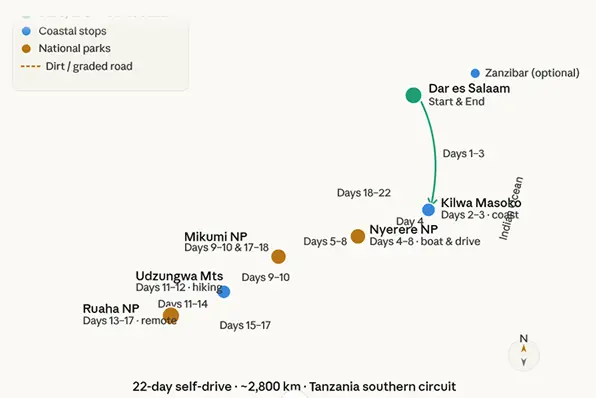
22-Day Tanzania Self-Drive Safari: Dar es Salaam → Coast → Southern Circuit
Overview
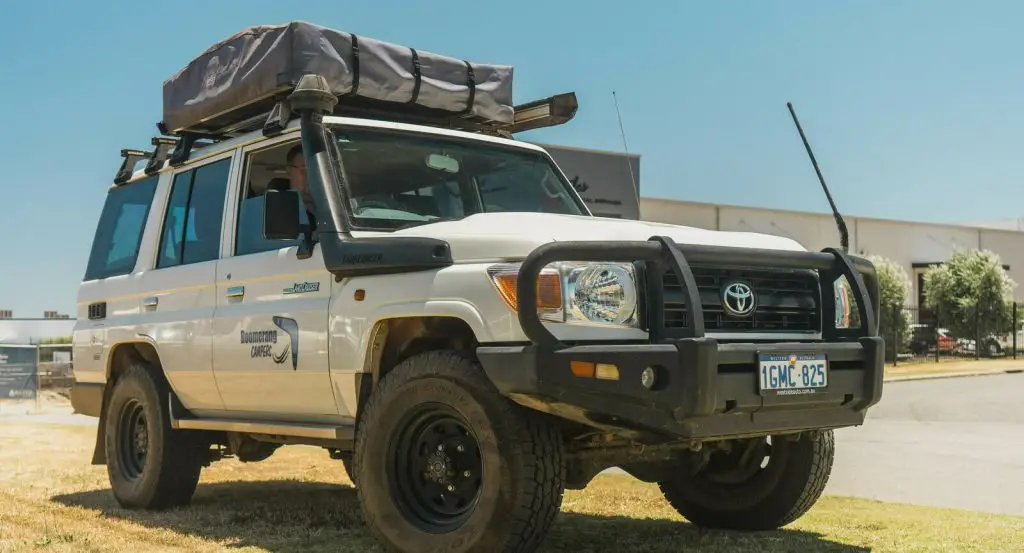
This route takes you from Tanzania’s commercial capital down the coast, then loops deep into the wild southern circuit before finishing back near Dar. You’ll cover roughly 2,800 km on a mix of tarmac and graded dirt roads. A 4×4 with high clearance is non-negotiable — particularly for Ruaha and Mikumi. Self-drive in Tanzania is genuinely possible, but demands preparation: carry extra fuel (jerry cans), a paper map backup, offline GPS (Maps.me or Gaia GPS downloaded in advance), and a first-aid kit.
Day-by-Day Itinerary
Days 1–2 — Dar es Salaam: Arrival & Prep Fly into Julius Nyerere International Airport and spend your first full day in Dar getting sorted. Pick up your 4×4 rental (book well in advance — reputable operators include Authentic Tanzania, Forodhani Car Hire, and Easy Travel). Stock up at Game supermarket in Masaki: water, snacks, a physical road map, and your offline GPS. Stay in the Masaki or Oyster Bay peninsula area — mid-range options like the Kunduchi Beach Hotel or Colosseum Hotel offer good value. Spend the afternoon at the National Museum and Kariakoo Market to ease into Tanzanian rhythms.
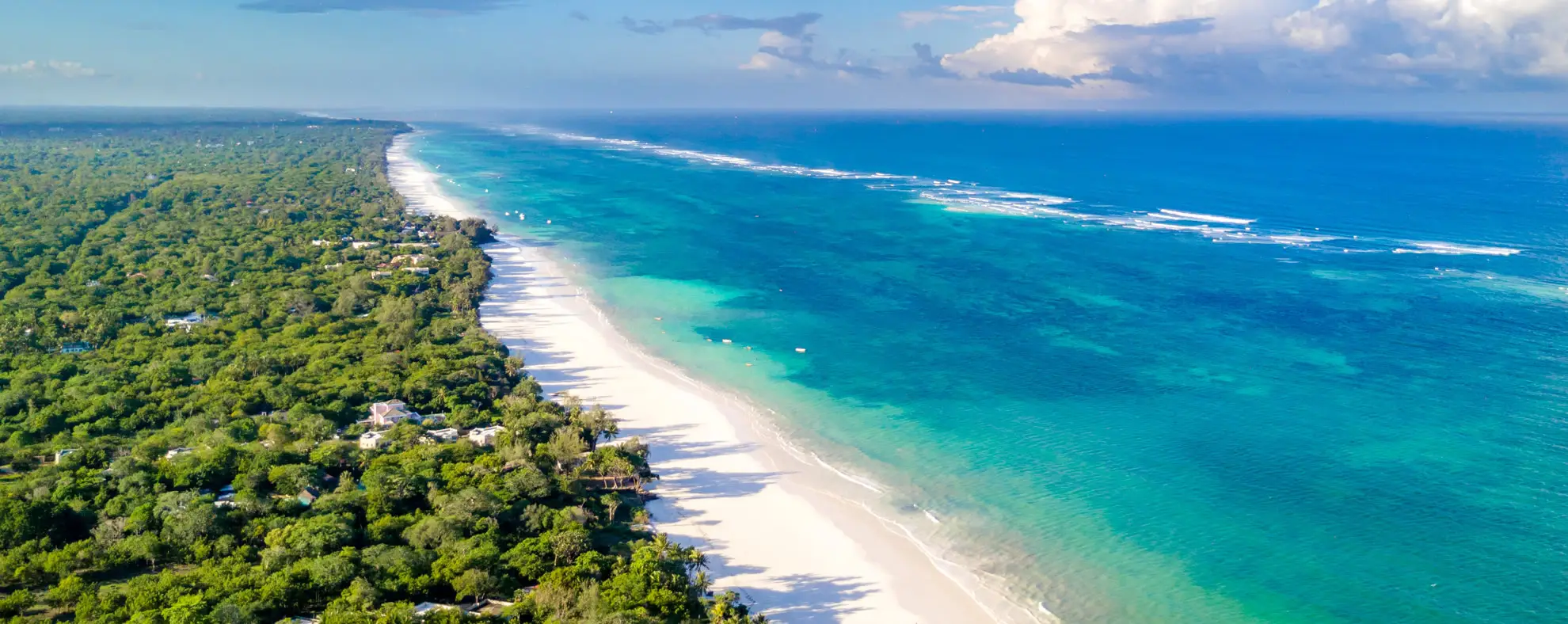
Days 3–4 — Drive South to Kilwa Masoko (~6 hours) Head south on the A7 highway, crossing the Rufiji River by ferry at Mkongo (budget 1–2 hours for the ferry queue — it’s an experience in itself). Kilwa Masoko is one of Tanzania’s most underrated destinations — a small fishing town with extraordinary Swahili ruins. Check into Kilwa Dreams Lodge or the budget-friendly Mviwani Beach Camp, both right on the water. On day 4, charter a boat to Kilwa Kisiwani, the UNESCO-listed island with a medieval Arab-Swahili trading port including the remarkable Husuni Kubwa palace ruins. The town is almost entirely tourist-free, so enjoy the solitude.
Days 5–9 — Nyerere National Park (former Selous Game Reserve) Drive back north slightly and swing west on the B2 toward Mloka Gate (~3 hours from Kilwa). Nyerere is Tanzania’s largest national park and Africa’s largest protected area — a genuinely wild place. Mid-range options here include Selous Impala Camp and Old Hippo Camp, both on the Rufiji River. Activities at Nyerere are uniquely diverse: game drives, walking safaris, and Rufiji River boat safaris all in the same park. The boat safari is unmissable — pods of 50+ hippos, Nile crocodiles, and elephant herds drinking at the bank. Wildlife highlights include African wild dog (Nyerere has one of Africa’s healthiest populations), lion, buffalo, elephant, and an extraordinary diversity of birds (~440 species). Dedicate four full days here — it deserves it.
Days 10–11 — Mikumi National Park (~3.5 hours from Mloka) Drive west on graded dirt then join the TANZAM highway (A7) toward Morogoro, entering Mikumi National Park, which straddles the highway itself. Hippo Pool just inside the gate is one of the easiest large mammal sightings in Tanzania — dozens of hippos year-round. Mid-range lodges include Vuma Hills Tented Camp (superb hilltop views) and Stanley’s Kopje. Mikumi is excellent for lion and elephant and is far less visited than the northern circuit parks. Two days gives you a morning and full-day game drive.
Company
Features
Most Recent Posts
- All Post
- Personal
- Professional
- Self drive Tours
- Seo

Days 12–13 — Udzungwa Mountains National Park (~2 hours from Mikumi) A complete change of pace. Turn south on the road toward Ifakara to reach Udzungwa, one of East Africa’s most biodiverse mountain rainforest parks. Unlike virtually every other Tanzanian park, Udzungwa has no vehicle safaris — it’s purely walking. The Sanje Waterfall trail (3–5 hours return) is magnificent, passing through thick montane forest with resident Angolan colobus monkeys and the endemic Sanje crested mangabey, found nowhere else on earth. Stay at Hondo Hondo Udzungwa Forest Camp, which sits right on the park boundary. A deeply refreshing contrast to the open savanna parks.
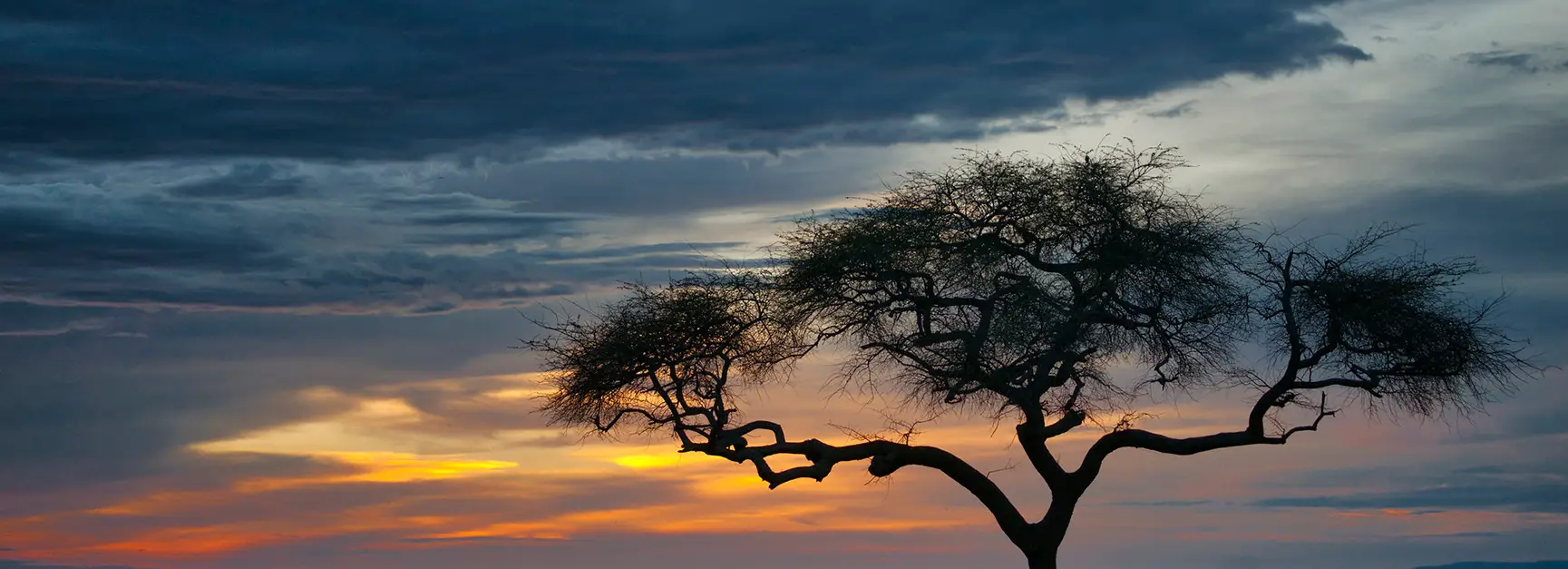
Days 14–17 — Ruaha National Park (~4 hours from Udzungwa on dirt roads) This is the jewel of the southern circuit and Tanzania’s second-largest park. The road from Udzungwa to Iringa is tarmac; from Iringa to Ruaha’s Msembe Gate is graded dirt (condition varies by season — inquire locally). Ruaha is remote, raw, and extraordinary. The Great Ruaha River is the spine of the park — a lifeline in the dry season where elephant, lion, leopard, buffalo, greater and lesser kudu, and roan antelope all converge. Mid-range accommodation includes Kwihala Camp, Jongomero (slightly higher-end but worth it), and the more affordable Mwagusi Safari Camp. Budget four days here: two full game drives daily, following the river in the morning golden light is something you won’t forget. Ruaha consistently records some of the highest lion densities in Africa.
Days 18–19 — Return to Mikumi via Iringa (transit + one more night) Drive back northeast to Iringa town — spend a night here if you’re tired; the Isimila Stone Age site just outside town is a fascinating detour. Then continue to Mikumi for one final game drive, approaching from the western side of the park which receives even less traffic than the main gate area.
Days 20–21 — Drive back to Dar via Morogoro The TANZAM highway back to Dar is mostly good tarmac — about 5 hours without stops. Break the journey in Morogoro, a pleasant town at the foot of the Uluguru Mountains. If time allows, take the Kisolanza Farm route for a scenic back road through the Kilosa district. Arrive in Dar by late afternoon. Final night: treat yourself — Protea Hotel Dar es Salaam at Oyster Bay or the Hyatt Regency offer mid-to-upper range comfort before your flight.
Day 22 — Departure Buffer day for flights and last-minute browsing at the Tingatinga Arts Cooperative Society in Oyster Bay, where Tanzanian artists sell the vivid, rounded-figure paintings the country is famous for.
Practical Notes
Best time to go: June through October (dry season) is ideal — roads into Ruaha and Nyerere are passable, wildlife congregates around water, and the bush thins out for better sightings. Avoid March–May (long rains) when dirt roads to Ruaha can become completely impassable.
Fuel: Carry 2× 20-litre jerry cans. Fuel stations are reliable in Dar, Morogoro, Iringa, and Kilwa — but between Mloka (Nyerere) and Ruaha, you are largely on your own.
Road conditions: The TANZAM highway is your friend — good tarmac most of the way. The Mloka–Nyerere entry road, Mikumi–Udzungwa road, and especially Iringa–Ruaha are the challenging stretches. After any rainfall, check road conditions with your lodge before departing.
Park fees: All Tanzania national park fees are paid via the TANAPA system using a Visa/Mastercard or the Tanapa e-Payments app. The southern circuit parks are significantly cheaper than Serengeti and Ngorongoro — roughly $50–70 USD per person per day entry.
Accommodation budget: Mid-range tented camps in the southern circuit typically run $150–300 per person per night full-board, which is outstanding value compared to the northern circuit equivalents. Book at least 6–8 weeks ahead for dry season travel.
This trip rewards patience and flexibility — the southern circuit is Tanzania’s least-visited and most authentic wildlife region. You’ll drive for hours without seeing another tourist vehicle, which is increasingly rare in East Africa.