The Okavango Delta, Botswana — 4×4 Self-Drive Safari & Travel Guide
What It Is and Where It Sits – The Okavango Delta is located in northwestern Botswana, right in the heart of Southern Africa, at the northern edge of the Kalahari Desert, between the border with Namibia and Makgadikgadi Pans National Park. It is, in the most literal sense, a miracle of geography. A delta is usually a wetland created at the point where a river meets another body of water, but the Okavango Delta is a prime example of a rarer phenomenon: it is where the Okavango River empties into the Kalahari Basin rather than flowing into an ocean or lake.
With an extension of 15,846 km², it is one of the largest inland deltas worldwide. Formed by tectonic faulting, this water-wonderland stores up to 95% of Botswana’s total fresh water. The result is a vast wetland ecosystem of floodplains, swamps, marshlands, lagoons, and islands constantly shifting and transforming. The delta is divided into four main areas: the Okavango Panhandle, the Eastern Delta, the Inner Delta, and the area around Moremi Game Reserve.

The Okavango Delta in Botswana is one of Africa’s most extraordinary wilderness destinations — a UNESCO World Heritage Site where the Okavango River fans out into a vast inland delta teeming with wildlife. Here’s what you can do there:
Safari & Wildlife
- Game drives — Day and night 4×4 safaris through the bush to spot the Big Five (lion, leopard, elephant, buffalo, rhino), wild dogs, cheetah, and hundreds of bird species.
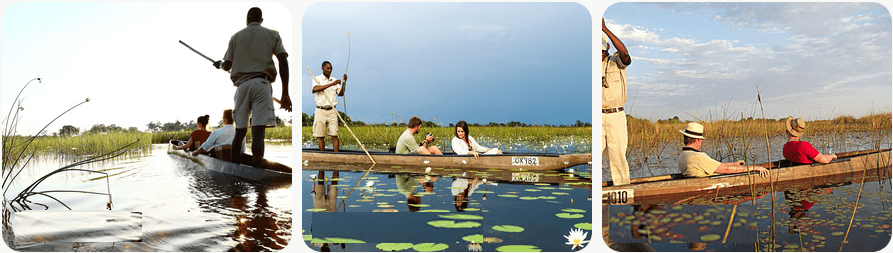
- Mokoro (dugout canoe) excursions — Gliding silently through papyrus-lined channels is one of the delta’s most iconic experiences, getting you close to hippos, crocodiles, and waterbirds.
- Bush walks — Guided walking safaris with armed rangers give you an intimate, ground-level encounter with the ecosystem.
- Boat safaris — On deeper waterways, motorized boat tours let you cover more ground and spot aquatic wildlife.
Bird Watching With over 400 bird species, the delta is a paradise for birders. Look out for the African fish eagle, saddle-billed stork, malachite kingfisher, and countless others.Water & Island Activities
- Fishing — Tigerfish, bream, and catfish are popular catches in the delta’s waterways. The Okavango is one of southern Africa’s best sport-fishing destinations.
- Island exploration — The delta is dotted with palm-fringed islands where you can explore on foot and enjoy sundowner drinks at sunset.
- Swimming (in safe designated areas) — Some camps offer guided swims in clearer, croc-free spots.
Cultural Experiences
- San Bushmen visits — Learn ancient tracking, fire-making, and survival skills from the indigenous San people, one of the world’s oldest cultures.
- Village visits — Engage with local communities around the delta and learn about their traditional way of life and relationship with the land.
Aerial Experiences
- Helicopter or light aircraft flights — Seeing the delta from above reveals its stunning mosaic of channels, floodplains, and islands — truly breathtaking, especially during flood season (May–August).
- Hot air balloon rides — Available at some camps for a peaceful aerial view at sunrise.Best Time to Visit
- May to October is peak season — dry season means wildlife congregates around water, and the annual flood (June–August) transforms the delta dramatically.
- November to April is the green season — fewer crowds, lush scenery, and excellent birding.
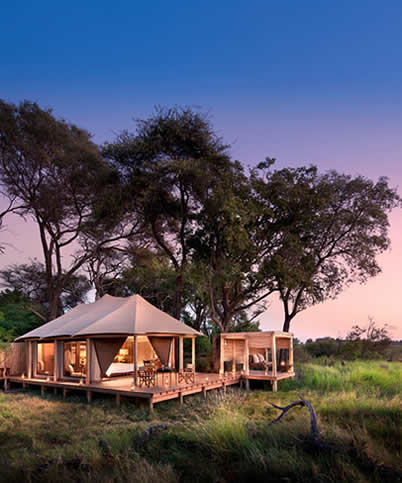
The Okavango Delta is best explored from a luxury or mobile tented camp, many of which are only accessible by small aircraft, adding to the sense of remote adventure. It truly is one of Africa’s last great wild frontiers.
Visitng Okavango Delta and options for accommodations.
Midrange Options
For midrange travellers wanting permanent lodge comfort without luxury prices, the Khwai area is the best starting point. The Khwai area is regarded as one of the most productive wildlife areas surrounding the Okavango and, being a community concession, it allows for off-road driving and night driving. Several midrange camps here offer tented accommodation with en-suite facilities, guided game drives, and mokoro excursions at a fraction of the cost of the deep-delta luxury lodges.
Drotsky’s Cabins in the Okavango Panhandle offers luxury cabins with en-suite facilities equipped with air-conditioning, satellite TV, and double beds. It is an ideal fishing lodge and an amazing place to enjoy a boat cruise on the Okavango River, and a preferred stopover for travellers en route to and from Namibia.
Camping Sites
Third Bridge and Xakanaxa are the best public rest camps in Moremi Game Reserve. Khwai Community Campsite (Mogotho) is a great camping spot on the edge of the Okavango, run by the local Khwai community. These public campsites put you right in the heart of wildlife territory, with minimal facilities but maximum immersion. Entrance to Moremi Game Reserve costs around $11 per person per day. Camping is also available within some of the surrounding concessions such as the Khwai Community Concession, where visitors can experience gliding along the waterways in a traditional mokoro. For self-drivers looking for a classic Okavango Delta boating experience, safari excursions deeper into the delta are available from Mboma Boat Station in the Moremi.
The Flooding Paradox
One of the most extraordinary things about the Okavango is when it floods. The Okavango’s flood arrives from Angola in the dry season, peaking in July — so the best months for water-based safaris and peak game viewing are May to August. During the rainy season, which peaks in January, Angola’s rivers swell with excess water, which then flows toward Botswana. It takes several months to reach the Okavango Delta and empty out onto the land, triggering the annual flood. In essence, the delta blooms when the surrounding Kalahari is at its driest, drawing wildlife in from vast distances.
About
- 4×4 Road Trips
- /
- The Okavango Delta
Wildlife and Biodiversity
To date, 71 species of fish, 33 species of amphibians, 64 species of reptiles, 444 species of birds, and 122 mammal species have been recognised in the Okavango Delta. You’re likely to spot endangered species such as cheetahs, lions, wild dogs, and both black and white rhinos, as well as buffalo, hippos, hyenas, wildebeests, warthogs, and dozens of other animals.
In the peak season of March to August, around 260,000 mammals congregate in the delta. The most abundant large mammal is the lechwe — a semi-aquatic antelope perfectly suited to the flood-adapted ecosystem. The delta is a paradise for aquatic species such as hippos and Nile crocodiles, and species that usually live in swamps, such as the sitatunga, lechwe, and waterbuck, are common visitors. Predators are well-represented too: the African wild dog, one of the continent’s most endangered carnivores, roams here in packs, and lion prides stalk buffalo through the papyrus.
The variety of birds in the delta is especially impressive; more than 400 different species have been spotted here. Some of the most impressive are the colourful lilac-breasted roller, the elegant slaty egret, and the enormous Pel’s fishing owl.
How You Experience It
The delta offers something unavailable at most other safari destinations: the ability to explore its ecosystem at water level. Bush walks, off-road safaris, and night-time game drives are permitted across much of the delta. So too are mokoro canoe rides — a unique opportunity to experience the ecosystem at water level, eye to eye with hippos and herons. The mokoro is a traditional dugout canoe poled silently through the channels by local guides from the BaTawana people who have lived on the delta’s edges for generations.
Beyond water excursions, game drives, guided walking safaris, scenic flights over the delta, and even hot air balloon rides are on offer from many camps. The guides in Botswana are some of the most decorated in Africa — it can take years to make the grade and earn the qualifications needed to pair up with a lodge or tour company.
Popularity and Conservation Status
The Okavango Delta occupies a unique position in the safari world: it is simultaneously iconic and deliberately uncrowded. On 22 June 2014, the Okavango Delta became the 1,000th site to be officially inscribed on the UNESCO World Heritage List. It has also been declared one of the Seven Natural Wonders of Africa. In 2017, the delta received 52,638 visitors, of whom 43,363 were international tourists and 9,275 were locals — a small fraction of the 1 million international tourists Botswana receives annually.
This is deliberate. Botswana has generally promoted a high-cost, low-volume tourism model in the Okavango region, intended to limit environmental impacts while generating high visitor expenditure. The inner delta has no permanent roads, and many camps are small tented establishments reachable only by light aircraft. This philosophy keeps the delta feeling genuinely wild. You are far more likely to share a waterway with hippos than with other tourists.
When Is the Best Time to Visit?
The best time to visit the Okavango Delta is during the dry season from June to October, when the rains have stopped and the flood waters have usually arrived. Although called the “dry season,” this is in fact when the Okavango waters are highest, as the flood waters arrive from Angola. The dry winter months are the best time to visit the Okavango Delta for big game viewing, due to the concentration of animals around the Okavango waters and the thin vegetation allowing good visibility.
Within that window, May and June offer a sweet spot: the flood is spreading rapidly, opening new mokoro routes almost daily. Skies are crystal clear, daytime temperatures hover around a pleasant 28°C, and the first cold mornings add a crispness to early game drives. Wildlife is concentrating around the advancing flood front, and the bush is thinning enough to make spotting easier. It’s the beginning of peak season, but not yet at full-peak pricing in most camps. July and August represent the absolute peak — water levels at their highest, temperatures comfortable, wildlife at maximum concentration, and mokoro and boat safaris fully operational. September and October are hotter and drier, with waters receding, but game viewing remains dramatic as animals crowd the shrinking waterholes.
The green season, from November to April, is one of the most overlooked but fascinating times to visit. The rains bring lush greenery, making it a paradise for photographers capturing the beauty of Botswana’s wilderness in full bloom. Many animals give birth during this season, so it’s a great time for those hoping to see baby animals. Additionally, the reduced number of visitors means you can enjoy a more private and peaceful safari experience. Birding is also exceptional during this period, with over 200 migratory species present. Rates are generally lower from November to April, with the most discounts during January to March.
Is the Okavango Delta Good for Self-Drive Safaris?
Yes — but with important caveats. The remote and aquatic nature of the Okavango Delta means self-drive safaris can be challenging but hugely rewarding and an excellent way for intrepid and independent travellers to see the delta.
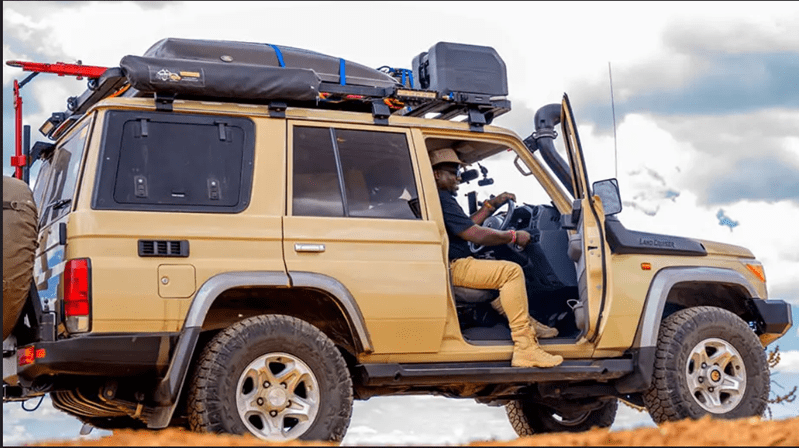
The other option for reaching the delta is to drive to Moremi Game Reserve in your own rented 4WD (usually with rooftop tent) along paved roads then unpaved tracks, usually from Maun. It’s also possible from Kasane via Chobe National Park and Khwai. Although there are many areas you’ll be unable to reach by road, the delta covers such a large area that there will still be more than enough accessible terrain.
You must have a good, reliable 4×4 with at least one spare tyre. It must be noted that the Okavango Delta is logistically challenging and safaris need to be well planned in advance. Fuel up fully in Maun before heading in — there are no petrol stations once you enter the reserve. It is also advisable to travel with two vehicles where possible, and to ensure someone outside knows your itinerary.
Once inside the park, you have access to all the same roads and trails as the safari companies that operate there. That means you can visit the exact same areas and have the chance to see the same wildlife, including lions, leopards, and elephants. The one experience you cannot access independently is the delta’s waterways — for mokoro and boat excursions, you will need to book through a local operator or camp.
Maun, in northwestern Botswana, is the gateway to the Okavango Delta. Flights to Maun arrive from Johannesburg, Cape Town, and other regional airports.
Budget and Midrange Accommodation and Camping
Budget Options
Most camping tours in the Okavango Delta start at US$100 to US$150 per person per day and can go higher. The more you’re expected to do while on safari (such as putting up and taking down tents, cooking, and washing dishes) and the fewer support staff accompanying you, the less you’re likely to pay.
Oddballs’ Camp is the classic budget choice for a fly-in delta experience. A simplistic and comfortable bush camp consisting of 15 dome tents set on elevated wooden decks, each with their own bush en-suite, Oddballs’ Camp is set on the fringes of Chief’s Island, beside Moremi Game Reserve. The activities on offer include walking and mokoro safaris with a local guide, offering a rare and life-changing experience as you venture deep into the delta.
Audi Safari Camp, located near Maun, is an ideal stop-over accommodation for self-drive safari-goers travelling to Moremi Game Reserve. Budget travellers on Botswana safari tours always choose to stay at this camp when travelling to Okavango, Chobe National Park, and the Kalahari. The place offers camping, tented, and house accommodations, with activities including walking safaris, mokoro trips, and educational safaris.